Christmas ham on the barbecue
A Christmas ham on the barbecue keeps the oven free and the kitchen cooler. Score, glaze and heat it with indirect fire, then watch the sugar at the end.
Jess Nguyen, Food editor · 2 December 2025 · 6 min read · 1,465 words
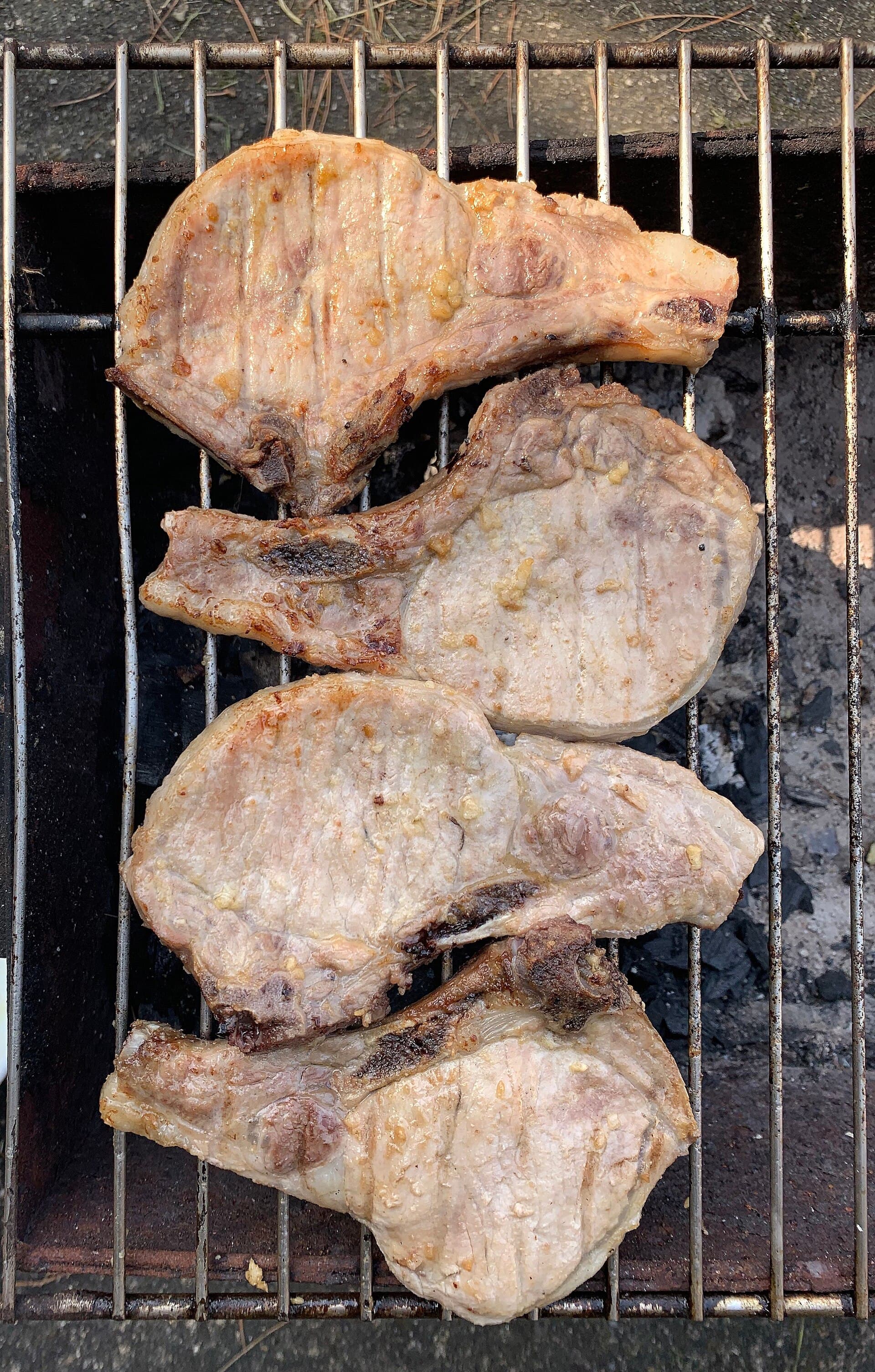
Photo: Pork chops cooked on a barbecue by Benoît Prieur. CC0 1.0. Source: Wikimedia Commons. See image credits.

Christmas lunch in an Australian kitchen is a heat problem before it is a food problem. The oven is full, the day is warm, and a large ham does not need the sealed box of a household oven to become palatable. It needs gentle, even heat and a glaze that does not burn. A hooded barbecue does that job if you treat the ham like a roast, not like a chop.
Most Christmas hams sold here are already cooked. You are reheating and flavouring. That is good news. It means you cannot “under-cook” a standard ready-to-eat ham in the way you can under-cook a whole chicken. You can dry it, burn the glaze, and leave it sitting in the sun. Those are the failures this piece tries to avoid.
The hero photograph on this article is pork on a grate, not a studded leg. The method below is still ham. If you would rather cook fresh pork chops on the day, use direct heat and a probe, and save the glaze for the ham you bought for the leftovers.
Why the barbecue is kinder than the oven
A ham wants 140 to 160 °C around it, not a blast. The barbecue, set up for indirect heat, is a slightly smoky oven with a door you already stand next to. The kitchen stays usable. The oven stays free for potatoes, a pudding, or nothing at all.
A four-burner hooded machine is the comfortable tool. Light one side. Sit the ham on the other, in a tray, so the glaze and dripping sugar do not hit the burners. A kettle works if the ham fits under the lid with space to spare. A kamado works with a deflector. A tiny portable without a hood does not. You need trapped heat.
Smoke should be a hint. A handful of apple wood or a clean chunk of something mild is enough. This is not brisket. Heavy smoke on an already-cured ham tastes like a bacon factory. If you have no wood, gas alone is still a better Christmas ham than a dried-out oven roast you forgot because you were making gravy.
December heat changes the rest of the day more than it changes the ham. The meat will warm a little faster. You will want the cook earlier or later, not at noon on a 38 °C deck. Cooking through an Australian heatwave applies to Christmas as much as it does to Australia Day.
Buying, soaking and scoring
Buy the largest ham you will actually eat. A full leg looks generous and becomes a fridge Tetris problem on Boxing Day. A half ham on the bone, or a boneless easy-carve, is enough for many households if there is seafood and salad. Bone-in eats better and stays moister. Boneless slices more neatly for a crowd.
Check whether it is ready to eat. The vast majority are. If you have a raw ham, you are in a different recipe: low heat, a probe, and a long afternoon. Do not glaze a raw ham as if it were a cooked one.
Some hams are mildly salty, some are very salty. A long soak is not always needed. If last year’s brand was harsh, soak this year’s in cold water in the fridge for a few hours, then dry it well. Do not soak on the bench.
Peel the skin if it is still on, leaving as much of the fat as you can. Score the fat in a diamond pattern, just through the fat, not deep into the meat. Deep cuts dry the slice. Studding with cloves is optional and traditional. If you stud, do it after scoring so you are not fighting the knife.
Bring the ham out of the fridge an hour before it goes on if the kitchen is cool. In a heatwave, keep it cold until the barbecue is ready. A warm December kitchen is not a proofing drawer.
Indirect glaze
Set the two-zone fire and a tray. Aim for a hood around 150 °C. Put the ham cut-side down or on its side, whichever is stable, fat-up so the fat bastes as it warms. Close the lid.
A half ham often wants 60 to 90 minutes to reach 60 °C in the centre, longer if it started very cold or if your hood leaks. A full leg can want two hours. These are ranges. Probe the thickest meat away from the bone. You are warming, not proving a point.
The glaze goes on late. Sugar, honey, marmalade, mustard, brown sugar and pineapple juice all burn if they sit over heat for an hour. Mix a glaze that tastes good on a spoon — mustard for sharpness, something sweet, a little vinegar or citrus so it is not flabby. Brush a thin coat when the ham is within 10 °C of done, or when the fat has started to look wet and rendered.
Glaze is the last fifteen minutes, watched. It is not a marinade you apply at 9 am and forget.
Close the lid after the first brush so it sets. Brush once more. If you want a darker coat, move the tray a little closer to the lit burners for five minutes and do not walk away. Burnt sugar is bitter and looks festive only in photographs.
If the surface is browning too fast and the centre is still 50 °C, foil the outside and keep going. If the centre is ready and the glaze is pale, it is better to have a pale ham than a dry one. A blowtorch at the table is a restaurant habit we do not require.
This is the same sugar problem described in marinades versus rubs. Treat the glaze as a finish.
Timing around a Christmas lunch
Work backwards from when you want to eat. The ham is happy to rest. It is not happy to sit carved in the sun.
Two hours before service: light the barbecue, set the tray, put the ham on.
Forty minutes before: first glaze, then watch.
Twenty minutes before: rest the ham on a board, loosely tented. The rest can be longer if you need the grate for prawns or a tray of vegetables. A rested ham slices more cleanly.
At service: slice only what you need. A whole carved ham dries. Leave the rest in a piece.
If you are also doing a turkey or a chicken, do the birds first or on a second fire. One grate with a ham tray and a whole bird is how both things steam and neither browns. How to host a backyard barbecue for a crowd is the logistics article. Christmas is a crowd even when it is only eight people, because the menu is larger than the fire.
Snags and leftover-ham toasties are Boxing Day. They are not a reason to crowd the Christmas grate.
Fire bans still exist in December in much of the country. Charcoal and wood may be out. Gas may be allowed. Check the morning’s rules. Bushfire-season barbecue safety is not only a January topic.
Leftovers and December food safety
The best Christmas ham is the one you eat for a week without getting bored or getting sick. Cool leftovers promptly. Wrap the remaining piece in a clean ham bag or a slightly damp tea towel changed daily, in the fridge, the way many Australian households already do. Slice what you need. Do not store a warm bone on the bench overnight because the party ran late.
Use the barbecue again for leftover ham if you want to. Thick slices on a moderate grate with mustard are a better Boxing Day lunch than another sweet glaze. Pineapple on the grate is optional and will flare if it is wet with juice. Pat it dry.
Ham stock from the bone is worth making when the house is cooler — evening, or the next day. Cover the bone with water, onion and a bay leaf. That is a soup, not a barbecue recipe, and it stops the bone occupying the whole fridge.
If the day was over 30 °C and the ham sat out for hours, be more conservative than a winter Christmas in Hobart would require. When rules of thumb and a long lunch disagree, the fridge wins. We are not your food-safety authority. We are the people who have thrown out a cheap ham rather than keep it.
A Christmas ham on the barbecue is a calm piece of cooking in a loud day. Indirect heat, a tray, a late glaze, a rest, and a knife that is sharp enough to slice rather than tear. Everything else is salads, shade and the sense not to light charcoal on a ban day because the photograph wanted smoke.
Questions readers ask
- Is a supermarket Christmas ham already cooked?
- Most Australian Christmas hams are cured and fully cooked. You are warming and glazing, not roasting from raw. Read the label. A raw cured ham is a different, longer cook.
- What temperature should the ham reach?
- For a ready-to-eat ham we warm the thickest part to about 60 to 65 °C so it is hot and the fat has softened. You are not chasing poultry numbers.
- Can I glaze a ham on a small Weber Q?
- Yes, if the ham fits with the hood shut. Use a trivet and one-burner indirect heat. A ham that forces the hood up will dry on one side and stay pale on the other.
- How long will leftover ham keep?
- In the fridge, well wrapped, several days is normal household practice. Freeze slices if you will not get through it. Do not leave a warm ham on a December table all afternoon and then put it away.
Keep reading
How to host a backyard barbecue for a crowd
Feeding a crowd on an Australian barbecue is a sequencing problem. Two zones, a short menu, cold drinks in the shade, and a plan for who eats when the first tray is ready.
Jess Nguyen · 16 April 2026
Vegetarian barbecue halloumi, mushrooms and vegetables
Halloumi, mushrooms and firm vegetables can be the whole barbecue, not a sad side. Give them two zones, oil, salt and the same attention you would give a chop.
Jess Nguyen · 6 April 2026
Seafood barbecue prawns, barramundi and bugs
Prawns, barramundi and bugs like a clean hot grate, a little oil and a short cook. Buy them cold, dry them, and take them off the fire as soon as they turn opaque.
Jess Nguyen · 22 January 2026